
Philadelphia's New Energy Code: What Architects and Designers Need to Know Before July 1, 2026
If you have projects heading to permit in Philadelphia this summer, mark July 1, 2026 on your calendar right now.
That is the date Philadelphia officially transitions to the 2021 Pennsylvania Uniform Construction Code, which adopts the 2021 International Energy Conservation Code with state-specific amendments. Any permit application submitted on or after that date must comply with the new standard. For architects and designers specifying fenestration, the changes are real and they are happening soon.
This post walks through exactly what changed, what it means for your current glazing specifications, and what you need to do before permits go in.
What Actually Changed
Philadelphia sits in Climate Zone 4 under the IECC system. The 2021 code tightens fenestration performance requirements compared to what most firms have been specifying under the 2018 standard.
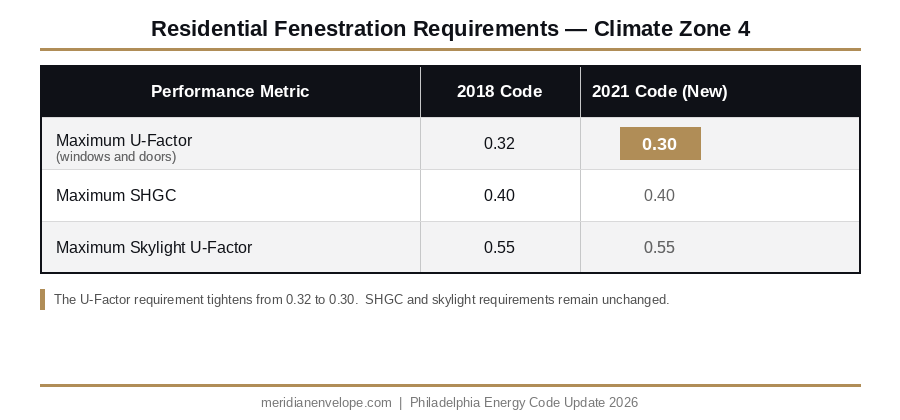
Here are the new prescriptive requirements for residential fenestration in Climate Zone 4:
For commercial fenestration under the 2021 IECC commercial provisions:
Fixed metal framing including curtain wall, storefront, and picture windows: U-0.38 maximum
Operable metal framing: U-0.40 maximum
Metal entrance doors: U-0.60 maximum
SHGC requirements vary by orientation and projection factor
The shift from U-0.32 to U-0.30 on the residential side might look small on paper. In practice it is a meaningful filter. A lot of commonly specified residential aluminum and vinyl products operate right in that U-0.30 to U-0.35 range. Products that passed plan review without a second thought last year may need a second look before July.
Why This One Feels Different
Code updates are nothing new. Most firms have a process for absorbing them. This transition feels different for a couple of reasons.
The timeline was compressed. The 2021 UCC adoption in Pennsylvania was confirmed more recently than a typical code cycle, which means the design and construction community has had less runway to update standard specs, details, and product selections. If your firm has not already reviewed its standard fenestration details against the new requirements, now is the time.
The U-0.30 threshold is a real product filter, not just a number adjustment. Many products that were perfectly compliant under the 2018 code are not compliant under the new one without a glass package upgrade or product substitution. That has real implications for projects in design development right now, not just projects heading to permit next week.
For firms doing contemporary residential work with larger format glazing and higher window-to-wall ratios, the whole-assembly U-factor calculation carries more weight than it used to. A project with 40 percent fenestration area and products at U-0.31 or U-0.32 will fail the prescriptive path and require a performance analysis. That adds time and cost to a permit submission that no one wants to absorb late in the process.
Your Two Compliance Options
Architects specifying fenestration under the new code have two primary paths to compliance. Understanding both helps you make smarter product decisions earlier in the process.
The Prescriptive Path is straightforward. Every window, door, and skylight in the project must individually meet the maximum U-factor and SHGC values in the code table. For residential projects that means every vertical fenestration product must carry an NFRC whole-window U-factor of 0.30 or better. There is no averaging and no trading off one product against another. Each product stands on its own.
The Trade-Off or Performance Path gives you more flexibility. This pathway allows an area-weighted average calculation across all fenestration on the project. You can use some products with higher U-factors as long as other products with significantly better performance offset them and the overall average meets the threshold. It takes more documentation and some energy modeling but it opens up product flexibility that the prescriptive path does not allow.
The Whole-Building Energy Simulation Path uses energy modeling software to demonstrate that the proposed building meets or exceeds the performance of a code-compliant reference building. This is the most flexible option but also the most documentation-intensive. It is typically used on complex commercial or mixed-use projects where the other pathways are too constraining.
For most residential and boutique multifamily projects, the prescriptive path is the practical choice. That means getting product selections right during design development, not scrambling to fix them at permit submission.
What to Check on Projects You Have in Design Right Now
Before any project heads to permit after July 1st, run through this checklist with your glazing specifications.
Check the whole-window U-factor, not center-of-glass. This is the most common source of confusion. Many product data sheets lead with center-of-glass U-factor values because they are more favorable. The number that matters for code compliance is the NFRC-certified whole-window U-factor, which accounts for the complete assembly including frame, glazing, and edge conditions. Make sure you are reading the right number.
Confirm NFRC certification is current and configuration-specific. A manufacturer being NFRC certified does not mean every product in their lineup is certified at every size and configuration. Confirm certification for the specific product, size, and glass package you are specifying. Expired certifications are also worth checking, especially on products your firm has been specifying for several years without revisiting.
Review your glass package assumptions. A lot of standard aluminum systems default to a basic double-pane low-E glass package that might have achieved U-0.32 under previous specifications. Upgrading to a higher-performance low-E coating with argon or krypton fill, or moving to a triple-pane package, is often the fastest path to U-0.30 without changing the frame system entirely.
Update your office master specs if they reference 2018 requirements. If your firm has standard specification language or window details that call out U-0.32 maximum performance, those details are now non-compliant for any permit submitted after July 1st. A specification that has not been updated is a plan review problem waiting to happen.
Think about window-to-wall ratio early. Projects with significant glazing area, typically above 30 to 35 percent fenestration-to-wall ratio, have less margin for error on the prescriptive path. If you are designing a contemporary home with substantial glass, running a quick fenestration area calculation early in design development is worth the time. It tells you whether the prescriptive path is feasible or whether you should plan for a performance pathway analysis from the start.
The Products That Are Already There
The good news is that if you have been specifying high-performance systems, you are likely already in good shape.
European aluminum systems are typically engineered to achieve assembly U-values of 1.3 W/m2K or better. Converting to US units that is approximately U-0.23, which is well below the new Philadelphia requirement. Architects who have been specifying European aluminum for modern residential projects are already compliant without changing a thing.
Passive House certified fiberglass systems perform even better, achieving whole-window U-factors as low as U-0.16 in US units. That is nearly double the performance the new code requires. For projects pursuing Passive House certification or targeting aggressive energy performance goals, fiberglass systems provide significant thermal margin that benefits the whole-building energy model.
High-performance domestic aluminum systems with upgraded glass packages can reach U-0.28 to U-0.30 at the whole-window level. If you prefer domestic supply chains, confirming the specific glass package with the manufacturer before design development is finalized is the critical step.
Standard builder-grade vinyl and aluminum products are the category most likely to need attention. Products that have been specified in the U-0.30 to U-0.35 range under the 2018 code will need glass package upgrades or product substitutions to comply going forward.
Documentation at Permit Submission
Plan reviewers in Philadelphia will require NFRC certification documentation to verify fenestration compliance on any permit submitted after July 1st. Having the right documentation organized before submission prevents the most common and most avoidable source of delay.
The NFRC Certified Products Directory is the primary verification resource and it is publicly searchable at nfrc.org. For each specified product the directory shows the certified whole-window U-factor, SHGC, visible light transmittance, air leakage, and condensation resistance for each specific configuration.
For permit submissions, include the NFRC product listing for each specified window and door product alongside the window schedule in your construction documents. Plan reviewers cross-reference those certified values against the code requirements. Having that documentation complete at submission is the difference between a smooth review and a correction notice that pushes your schedule back.
One thing worth knowing: for products without NFRC certification, the code defaults to assumed performance values from Table R402.1.4. Those assumed values are intentionally conservative and will typically fail the prescriptive requirements. Specifying uncertified products on a project heading to permit after July 1st is a plan review rejection waiting to happen.
Where Your Current Projects Stand
Projects in schematic design or early design development have the most flexibility right now. Specify to U-0.30 or better from day one and the transition creates no friction at all.
Projects in design development with preliminary product selections should run a quick audit now. For each specified window and door product, pull the whole-window U-factor from the NFRC directory. Products sitting at U-0.31 or U-0.32 need a glass package review or a substitution conversation with the manufacturer. Doing that now takes a few hours. Doing it at permit submission takes weeks.
Projects in construction documents targeting a permit submission after July 1st need immediate attention. Any products currently specified at U-0.30 to U-0.35 need to be resolved before the CD set is finalized. A fenestration compliance rejection at permit submission adds weeks to the schedule and creates the kind of conversation with a client that nobody enjoys.
Projects already permitted under the 2018 code that are currently under construction are not affected. Permitted projects continue under the code in effect at the time of permit issuance.
A Note on Commercial and Mixed-Use Projects
Commercial fenestration under the 2021 IECC operates under different requirements than residential. For boutique commercial, mixed-use, and multifamily projects in Philadelphia, the applicable provisions depend on the occupancy classification and how the project is coded.
For mixed-use projects with residential and commercial occupancies in the same building, the fenestration requirements may differ by floor or zone depending on how occupancy separation is handled in the code analysis. Confirm with your code consultant which provisions apply to each portion before finalizing fenestration specs.
Curtain wall and storefront systems on commercial projects must meet the commercial fenestration requirements, not the residential prescriptive table. For Climate Zone 4, fixed metal framing must achieve U-0.38 maximum under the commercial provisions. Most commercial aluminum curtain wall and storefront systems already meet this threshold with standard configurations.
Moving Forward
July 1st is close. The action items are straightforward.
Audit your current fenestration specifications against the U-0.30 residential and U-0.38 commercial thresholds. Confirm NFRC certification documentation is available and current for every specified product. Resolve any products that do not comply before construction documents are finalized. Update any standard office details or master specifications that still reference 2018 code requirements.
The transition itself is not an obstacle for architects already working with high-performance glazing systems. The requirements align with what well-designed contemporary buildings have been achieving for years. The risk is in projects where standard product selections have not been revisited with the new thresholds in mind.
If you have questions about specific product performance, NFRC documentation, or compliance pathways for a project currently in design, we are happy to help. Meridian Envelope Solutions provides complimentary glazing specification reviews for projects heading to permit in the Philadelphia and Northeast market.
Malik Shelton Managing Principal, Meridian Envelope Solutions 215-907-7790 | [email protected] | meridianenvelope.com Serving architects, builders, and developers across Philadelphia, South Jersey, Delaware, and the Northeast
